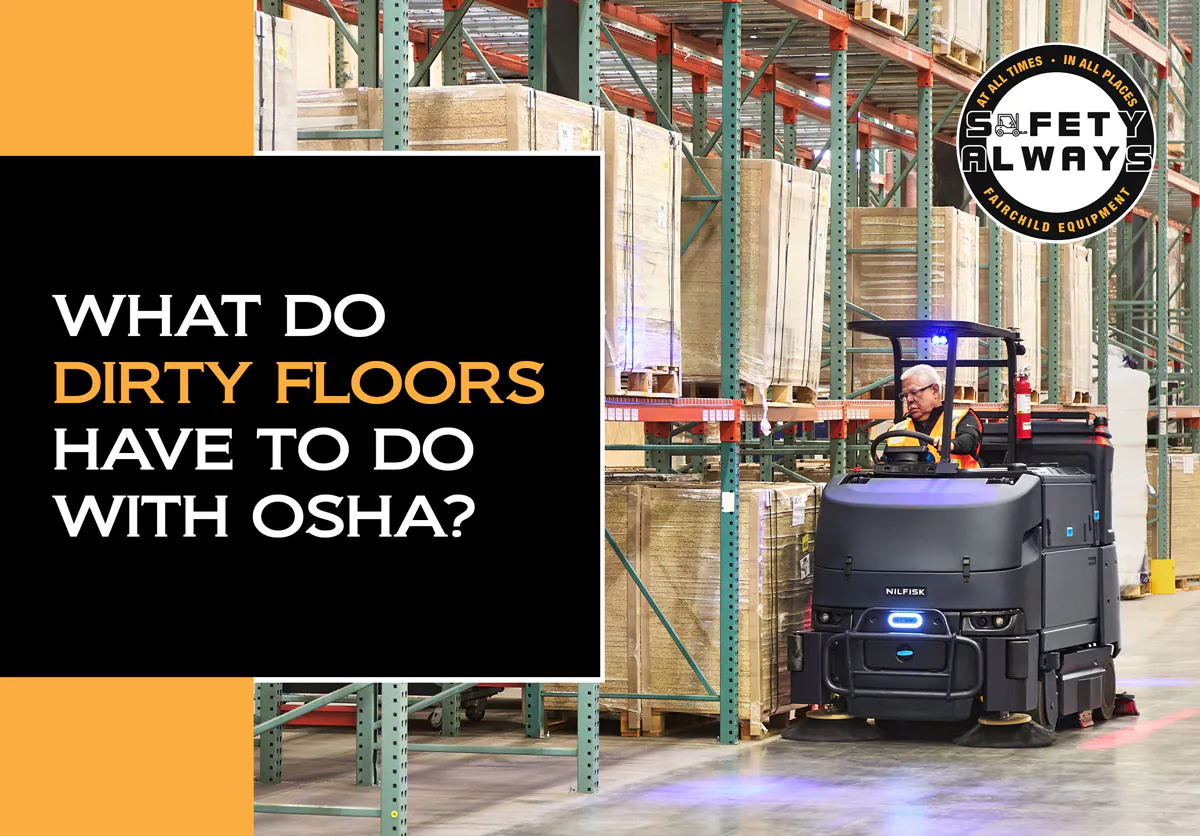
In the United States, the federal Occupational Safety and Health Administration (OSHA) is responsible for setting and enforcing national regulations that govern workplace safety. As far as OSHA is concerned, the more workplace hazards that exist in a given industry, the more scrutiny that sector receives under the law. Distribution, Manufacturing and Warehousing are some of those industries, as warehouses tend to have a greater than average concentration of workplace risk factors.
Of these risk factors, one in particular is linked to many other downstream hazards: floor cleanliness.
In other words, when floors are dirty, a whole lot more safety issues usually follow, with OSHA close behind.
OSHA’s Stance on Warehouse Floor Safety
OSHA has an entire group of regulatory standards dedicated to floors known as General Industry Part 1910 Subpart D – Walking-Working Surfaces. In this section, walking-working surfaces are defined as “any horizontal or vertical surface on or through which an employee walks, works, or gains access to a work area or workplace location.” For warehouse spaces, this refers to the entire warehouse floor, all elevated mezzanines, catwalks, work decks, ladders, staircases, equipment platforms, and the like.
Now with OSHA being OSHA, the 1910 Subpart D section gets hyper-detailed on the riskiest activities such as climbing ladders and working at heights, but stays broad on general activities like walking across a warehouse floor. In fact, floor conditions are covered in only one section – 1910.22 General Requirements. However, this does not mean that OSHA is more lenient on floor accidents!
What this really means is that OSHA takes a simple yet firm stance on floor safety: every employer must provide safe walking-working surfaces for their employees, and any accident that can be traced back to unkempt floors is an actionable compliance failure.
How Warehouse Floor Cleaning Addresses Specific OSHA Compliance Requirements
Next, let’s break down how improving floor cleanliness directly addresses critical OSHA workers’ safety compliance requirements:
- Working Environment Quality – OSHA requires that employees are provided clean, safe working environments, which typically refers to managing contaminants such as dust, dirt, oil, grease, mold, bacteria, fumes, pests, allergens, condensation, and pollutants. To stay OSHA-compliant, these contaminants must be cleaned before they build up to unsafe environmental quality levels.
- Access & Egress – employees must be provided safe, protected egress paths to and from all work areas, free of any obstructions and surface hazards that could cause difficulty in navigating the warehouse. Keeping floors clean will eliminate associated risks such as slip and trip hazards, obscured floor markings, and blocked paths.
- Hazardous Conditions – there are two cases in which floor soils become classified as high-hazard risks: dust settling to the point that it reaches combustible concentrations, and spills of defined hazardous materials such as flammable and explosive chemicals. In both cases, cleaning up these soils at first detection is the only way to satisfy OSHA as well as NFPA (National Fire Protection Agency) requirements.
- Fire Extinguisher Access – since we mentioned the NFPA above, let’s point out another fire-related requirement. OSHA and the NFPA require that fire extinguishers are fully accessible at all times, which means that floors need to be kept clean to ensure employees can reach extinguishers when they need them.
- Product Protection – dirty warehouse floors are notorious for transferring soils onto stored products, which in turn causes a great deal of extra employee labor to inspect and clean products before they ship out. While keeping products clean itself is not an OSHA requirement, the added ergonomic strain and worker stress of cleaning products ‘is’ an OSHA requirement, which can be largely avoided by keeping floors clean.
- Food Safety – building on the above point, keeping products clean in a food manufacturing or distribution environment is an OSHA requirement, not to mention an FDA and criminal law requirement as well. For this reason, warehouses handling food products must keep their floors clean as a matter of ensuring food safety.
Tips for Effective, Compliant Warehouse Floor Cleaning
Now that you understand the connection between floor cleanliness and OSHA regulations, what actions can you take to keep your warehouse floors in compliance? Here are our suggestions:
- Launch a Standardized Floor Cleaning Program – establish a formal cleaning program designed around OSHA floor safety compliance. Include standardized policies and procedures covering cleaning equipment, immediate spill responses, notification and signage, proper PPE (personal protective equipment), floor inspections, and employee training.
- Establish a Cleaning Schedule – since floor cleaning won’t get accomplished if it’s not scheduled and assigned, next create a routine cleaning schedule that covers all cleaning functions, not just floors. This schedule should include daily, weekly, monthly, and quarterly tasks based on your warehouse’s operations.
- Define Cleaning Zones – next, break your warehouse space down into logical cleaning zones distinguished by their uses, risk factors, soils, and traffic volumes. Ideally, your cleaning schedule will flow through zones to minimize operational interruptions and focus cleaning intensity where it’s most needed.
- Utilize Wet and Dry Cleaning – combine wet and dry cleaning methods to balance cleaning speed and soils removal both by zones and schedule. As an example: perform daily dry sweeping and vacuuming followed by weekly wet scrubbing in the main racking zones, and perform daily wet scrubbing in the dock.
- Specify Exact Cleaning Parameters – warehouse floor cleaning should be conducted according to exact specifications that must be met for cleaning to be deemed successful. Common parameters include chemical concentrations, scrubber pressure, wash water temperature, and vacuum travel rate.
- Select Ideal Chemicals – speaking of chemicals, always select chemicals that match your particular soils and cleaning requirements. For example, you’d use different chemicals for grease spills than you would for general disinfecting.
- Address Soils Sources – do your best to track down the root causes of floor soils to begin with, as many sources are quite easy to repair. Examples include cleaning dirt buildup on light fixtures, replacing door seals, installing new HVAC (heating, ventilation, and air conditioning) filters, sealing skylights, and increasing positive warehouse air pressure.
Through these tips and an overarching dedication to managing floor conditions, your warehouse is sure to meet and exceed OSHA’s Walking-Working Surface cleanliness requirements.
We hope that this discussion has been helpful for your commercial material handling and operational needs. Fairchild Equipment is the Upper Midwest’s premier Material Handling Equipment and Service resource, with headquarters in Green Bay, Wisconsin, and numerous locations ready 24/7 to serve your needs throughout Wisconsin, Minnesota, North Dakota, Michigan’s Upper Peninsula and Northern Illinois. For more information or to discuss which equipment solution might be best for you, please call us at (844) 432-4724 or send us a message.